

Tax refund season and home buying season land at almost exactly the same time every year — here is how to use your tax refund to buy a home! For a lot of buyers, that refund check is the missing piece for first time home buyers.
The average federal refund this year is running close to $3,700. That’s real money. And if you’ve been sitting on the fence about buying a home, it might be exactly what you need to get started.
Yes, Your Tax Refund Can Be Used as a Down Payment
One of the most common questions we hear: “Can I actually use my refund for a down payment?” Yes — 100%. IRS tax refunds are an accepted source of funds for most mortgage programs, as long as the money is properly documented.
The good news is you don’t need a massive refund to qualify. Several loan programs are built specifically for buyers who don’t have 20% sitting in the bank:
- FHA loans — require as little as 3.5% down. On a $200,000 home, that’s $7,000.
- Conventional loans — can go as low as 3–5% down, and the down payment can even be gifted by a family member.
- USDA loans — zero down payment for eligible rural properties.
- VA loans — zero down for qualifying veterans and service members.
A client once told me she’d been renting for six years waiting to “save up enough.” When we ran the numbers, her $4,800 refund combined with a small amount already in savings put her over the threshold for an FHA loan. She closed two months later. She had no idea it was even possible.
Learn more about our FHA loans with down payment assistance here.
Renting vs. Buying: What the Numbers Actually Look Like
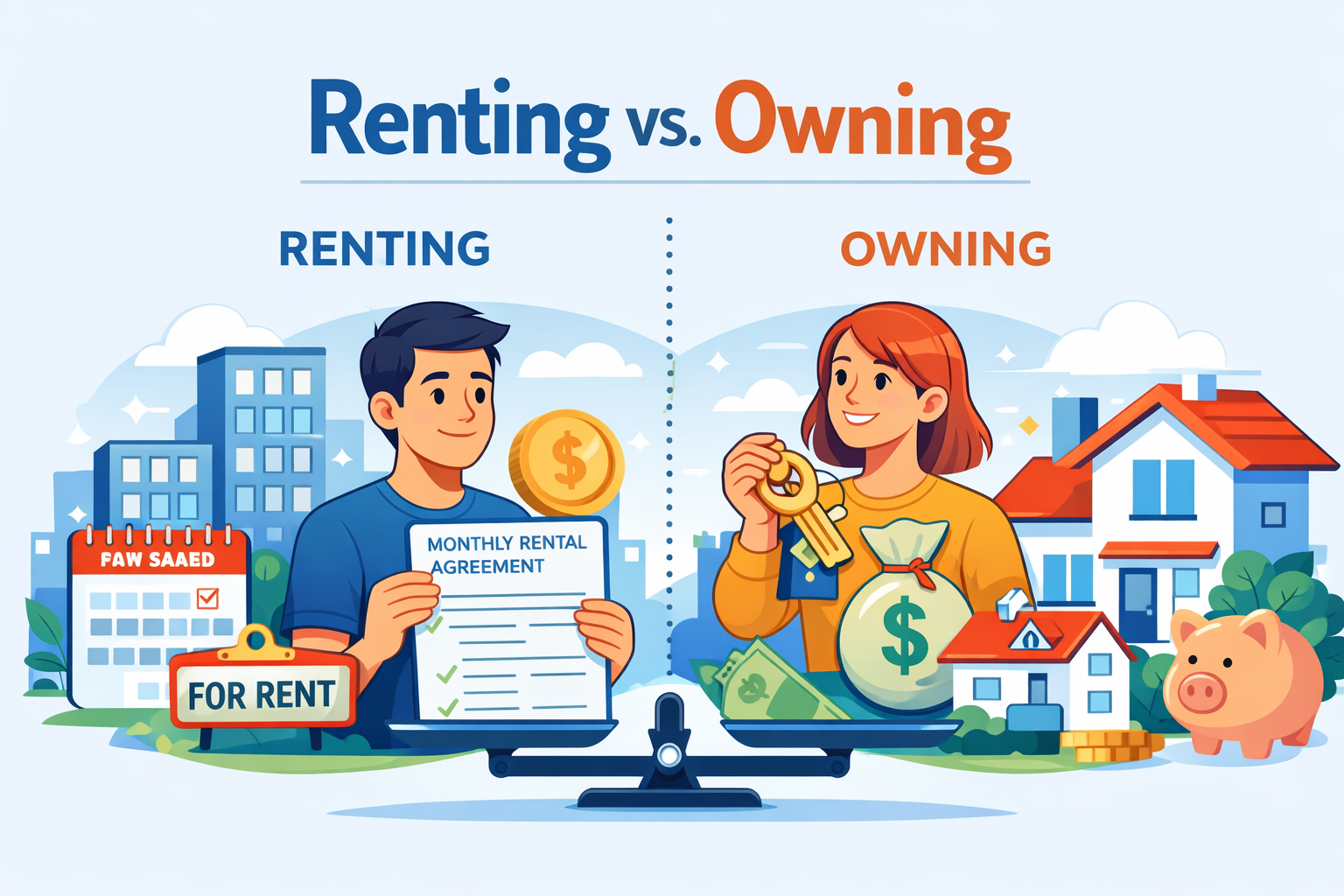
A lot of people assume renting is the cheaper option. And in the short term, it often is — lower upfront costs, no maintenance bills, no property taxes. But stretch that thinking out five or ten years, and the math flips pretty quickly.
Here’s the part that stings: every rent check you write is building your landlord’s equity, not yours. When you rent, you’re covering their mortgage, their taxes, and their profit margin. You get a place to live. They get an appreciating asset.
When you own, that same monthly payment starts working for you.
The Monthly Payment Myth
One of the biggest misconceptions we hear is that a mortgage payment is always higher than rent. In Michigan, that’s often simply not true.
Think about it this way: if you’re renting a two-bedroom apartment in Grand Rapids for $1,500 a month, you might be surprised to find out that a mortgage on a $200,000 home — with an FHA loan at 3.5% down — could land in a similar range. And that mortgage payment? It stays fixed. Your rent doesn’t.
I’ve had clients who were paying $1,400 in rent, assumed they couldn’t afford to buy, and ended up with a mortgage payment of $1,320. That $80 monthly difference is now going toward something they own.
What About Closing Costs?
Down payment isn’t the only upfront cost. Closing costs typically run 2–5% of the loan amount, and a lot of buyers are caught off guard by them. Your tax refund can cover those too — things like:
- Loan origination fees
- Appraisal fees
- Title insurance
- Property tax prepayments
- Prepaid homeowner’s insurance
Many loan programs — including FHA and conventional — also allow sellers to pay a portion of your closing costs. Ask your loan officer about this before assuming you have to cover everything yourself.
Don’t Forget About the Earnest Money Deposit
When you make an offer on a home, you’ll typically put down an earnest money deposit — usually 1–3% of the purchase price — to show the seller you’re serious. On a $250,000 home, that’s $2,500 to $7,500, however in some scenarios a low as a $1,000 deposit may be appropriate.
This deposit isn’t lost money. It goes into escrow and gets applied toward your down payment or closing costs at the end. Your tax refund is a perfect source for this.
Use It to Pay Down Debt First (Seriously)
Here’s something most buyers don’t think about: using your refund to pay off a credit card or small loan can do more for your buying power than adding the same amount to your down payment.
Why? Two reasons. First, paying down debt improves your debt-to-income (DTI) ratio — one of the primary things lenders look at when approving your loan. Second, it can bump your credit score, which directly affects your interest rate. A better rate means a lower payment every single month for the life of the loan.
If your score needs work, even a few hundred dollars toward a high-balance credit card can move the needle. Talk to a loan officer before you decide how to split your refund.
Use our FHA mortgage calculator to estimate FHA mortgage payments.
What NOT to Do With Your Refund Before Buying
This part matters. Lenders have strict guidelines around where your down payment money comes from — and how you handle your refund could actually cause your loan to be denied.
- Don’t cash it out. If you receive your refund and immediately withdraw cash, a lender can’t trace where the money went. Untraceable cash creates a red flag — it can look like money laundering, even when it obviously isn’t. Keep the money in your bank account.
- Don’t spend it on something else. It sounds obvious, but that refund can feel like free money. It’s not — it’s your opportunity to get into a home.
- Don’t make large, unexplained deposits. Any unusual activity in your bank statements during the mortgage process will get scrutinized. Keep your paper trail clean.
The rule of thumb: deposit your refund, leave it alone, and document everything.
Start the Pre-Approval Process Now — Before Your Refund Arrives
You don’t have to wait for the check to hit your account. When you reach out to a loan officer at Riverbank, you can let them know how much you’re expecting back. They can use that amount in your pre-approval calculations right now.
Filing your taxes electronically with direct deposit is the fastest way to get your refund — most people see it within 21 days. The sooner you file, the sooner you can move.
The spring market in Michigan picks up fast. Getting pre-approved now, before your refund lands, means you’re ready to make an offer the moment the right home comes up — instead of scrambling to put your finances together while another buyer swoops in.
Other Ways to Stretch Your Refund Further
If your refund covers the down payment and you have money left over, here are a few smart places to put it:
- Home inspection costs — typically $400–$600, and absolutely worth every dollar.
- Moving expenses — professional movers for a local move average around $1,600; long-distance can hit $8,000.
- Emergency fund — new homeowners get surprised by unexpected repairs. A cushion in savings means you’re not panicking when the water heater dies six weeks after closing.
- Mortgage discount points — paying points upfront can lower your interest rate for the life of the loan. This makes sense if you plan to stay in the home long-term.
The Bottom Line
Your tax refund isn’t just a nice bonus — for a lot of buyers, it’s the bridge between renting and owning. Use your tax refund to buy a home with low down payment options available and refunds averaging close to $3,700 this year. There’s a real chance this tax season unlocks homeownership for you.
Deposit that refund. Don’t touch it. And call us at 800-555-2098.
Our loan officers at Riverbank Finance are ready to walk you through your options — no pressure, just real numbers. Get pre-approved today and find out exactly what you can afford.
For more information visit the CFPB’s Tools for Buying a Home