


Your parents want to sell you the house. They’re willing to give you a break on the price, what lenders call a gift of equity. You want to say yes, but you’ve got $4,000 in savings and the lender keeps talking about a down payment.
This is the exact situation a gift of equity was built for. Done right, you can buy a home from a family member and bring nothing to closing. Done wrong (and it goes wrong more often than you’d think), you end up needing $15,000 you don’t have, two weeks before the closing date.
The difference comes down to how the paperwork is written. Here’s how it actually works.
A gift of equity is the gap between what a home is worth and what a family member sells it to you for. Your lender treats that gap as money you already put into the house, so it can cover your down payment and closing costs. On a $300,000 home, a 10% gift of equity can mean $0 cash at closing.
What is a gift of equity?
A gift of equity is a credit a seller gives a buyer at closing, equal to some portion of the seller’s ownership stake in the home. It only works when the seller is a relative, and the buyer is getting a mortgage to buy the home.
Think of it like a trade-in. When you trade in a car, the dealer doesn’t hand you cash for your old vehicle. They knock the value off the price of the new one. A gift of equity works the same way: no money changes hands, the credit just reduces what you have to bring.
Equity, by the way, is just the part of the home your relative actually owns. A $300,000 house with a $120,000 mortgage balance has $180,000 of equity. The seller can gift some of that to you; they can’t gift the part the bank still owns.
Fannie Mae’s rule is short and worth reading: a gift of equity can fund all or part of the down payment and closing costs, including prepaid items like your first year of homeowners insurance. The only thing it can’t do is count as reserves, the savings a lender sometimes wants to see left over after closing.
How does a gift of equity work when buying a home from a family member?
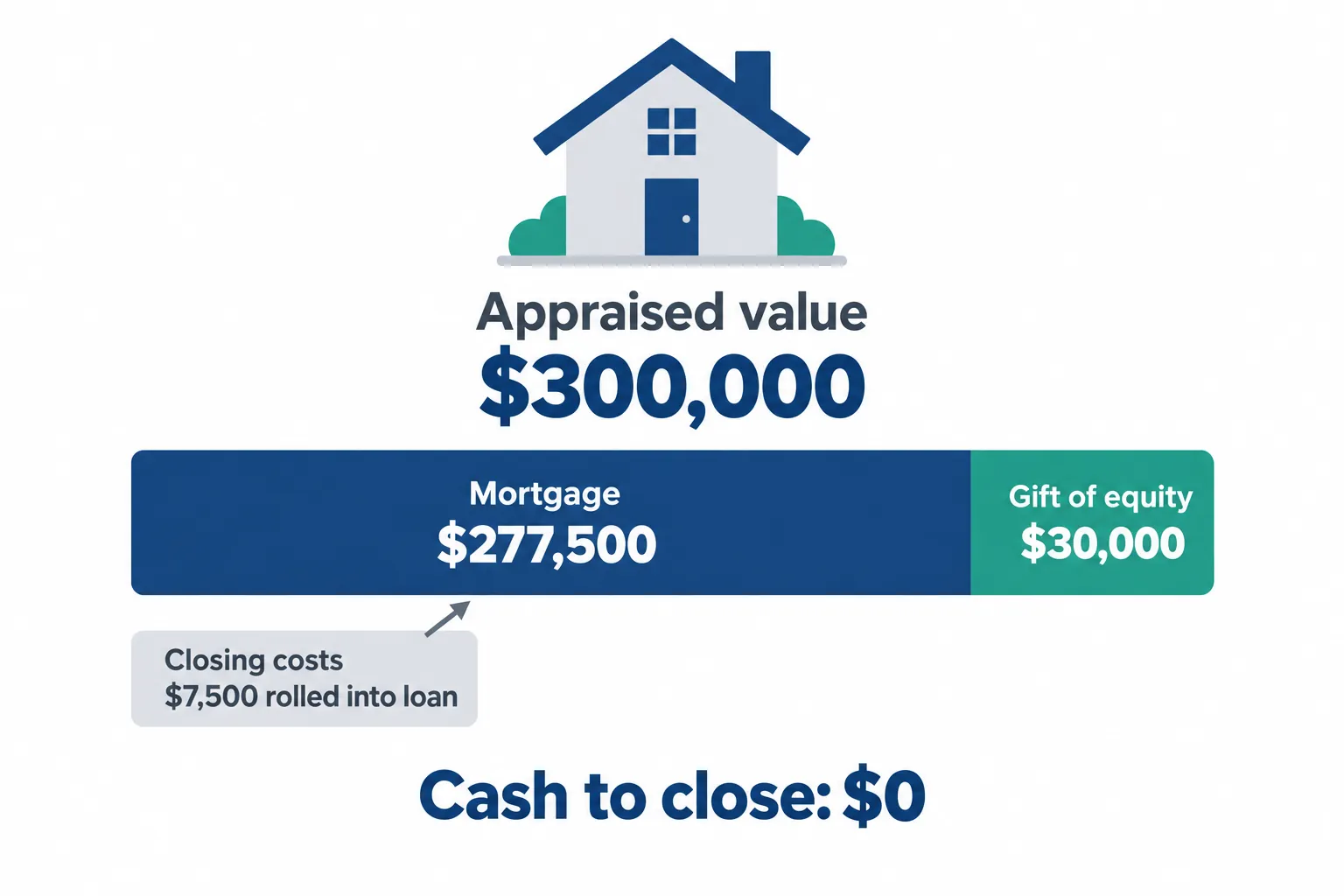
A gift of equity works in four steps: the lender orders an appraisal, the family agrees on the gift amount, the purchase agreement is written at full appraised value with the gift listed as a credit, and the gift shows up on the Closing Disclosure as money the buyer already contributed.
Here’s a real-shaped example. Your parents’ house appraises at $300,000. They agree to gift you 10%, or $30,000. Closing costs and prepaids run about $7,500 (figure 2% to 5% of the price on most purchases).
- Purchase price on the contract: $300,000
- Gift of equity credit: $30,000
- Closing costs and prepaids: $7,500
- Your loan amount: $277,500 (92.5% loan-to-value)
- Cash you bring to closing: $0
Notice the loan is $277,500, not $270,000. The gift covers your down payment and your closing costs, but the closing costs don’t disappear. They get folded into the loan, and the gift credit offsets them. As long as the final loan stays under the program’s maximum (97% of value on most conventional loans, 96.5% on FHA), this works.
Your parents walk away with $300,000 minus the $30,000 gift, minus their own selling costs, minus whatever they still owe on the house. Everyone should see that number in writing before anyone signs.
The mistake that costs buyers their zero-down deal
The situation that comes up most: a family agrees “we’ll sell it to you for $270,000,” and the real estate agent or attorney writes the contract at $270,000. No gift of equity line. Everyone thinks they did the same thing.
They didn’t. Lenders calculate loan-to-value using the lower of the purchase price or the appraised value. With a $270,000 contract, the lender sees a $270,000 house, lends at most 97% of it ($261,900), and now you owe a $8,100 down payment plus $7,500 in closing costs. That’s $15,600 in cash that the $300,000-with-a-gift version didn’t need.
Same house, same family, same discount. The only difference is whether the discount is written as a lower price or as a gift of equity credit against the full price. Always write it as the credit. Fannie Mae’s own definition says the gift is transferred to the buyer as a credit in the transaction, and the Closing Disclosure has to show it that way.
One small cost of doing it right: Michigan’s transfer tax is figured on the contract price, so a $300,000 contract costs the seller about $260 more in transfer tax than a $270,000 one would. Run both numbers in our Michigan transfer tax calculator. Against $15,600 in cash the buyer doesn’t have to find, it’s an easy trade.
Can a gift of equity cover both the down payment and closing costs?
Yes. On conventional and FHA loans, a gift of equity from a relative can cover 100% of the down payment and 100% of closing costs and prepaids, which is what makes a true no-cash purchase possible. The limit isn’t the gift; it’s the maximum loan-to-value for your loan program and how much equity the seller actually has.
Two numbers worth knowing before you plan around this:
The 20% myth. Most people know that 20% equity on a conventional loan means no private mortgage insurance (PMI), the monthly fee that protects the lender when you put down less than 20%. But if the gift also covers closing costs, those costs get added to the loan. On a $300,000 home, a $60,000 gift with $7,500 of closing costs rolled in gives you a $247,500 loan, which is 82.5% LTV. PMI applies. To skip PMI and bring nothing to closing, the gift needs to be closer to 22% to 23% of the value. Round numbers matter here.
The seller’s payoff. A gift of equity can’t exceed what the seller actually nets. Here’s where this usually goes sideways: a brother sells his sister a $300,000 house, wants to gift her $60,000, and still owes $250,000 on his own mortgage. The math is $300,000 minus $60,000 minus $250,000 minus roughly $8,000 in seller costs. He’d have to bring $18,000 to his own closing. Get the seller’s mortgage payoff statement before you pick a gift amount, not after.
Gift of equity rules by loan type: conventional vs. FHA vs. VA
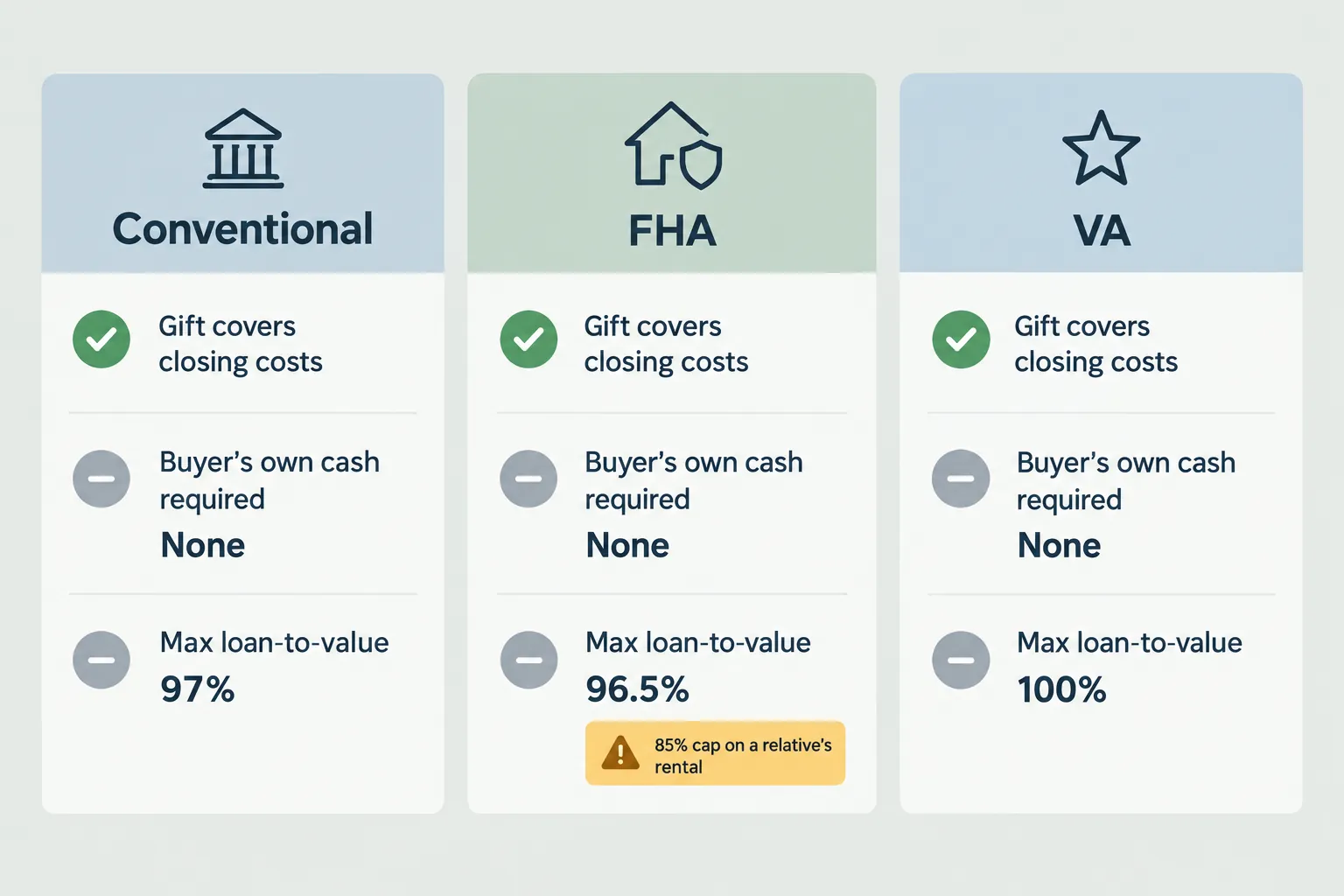
Conventional (Fannie Mae and Freddie Mac), FHA, and VA loans all allow a family member to help a buyer at closing, but each has its own rules on who can give, how much the buyer must contribute, and which properties qualify. VA is the odd one out: the VA Lender’s Handbook has no gift-of-equity provision, so a relative’s price break is simply a seller credit toward closing costs. Picking the wrong program is the second most common way these deals stall.
| Rule | Conventional (Fannie/Freddie) | FHA | VA |
|---|---|---|---|
| Who can give | Relative by blood, marriage, adoption or legal guardianship; also fiancé or domestic partner | HUD’s “Family Member” list only (parents, children, grandparents, siblings, aunts, uncles, in-laws, spouse or domestic partner) | No gift-of-equity rule of its own; VA treats the seller as an interested party, so the credit is handled as a seller contribution |
| Buyer’s own money required | None on a 1-unit primary home at any LTV; 5% of own funds on a 2–4 unit home or second home over 80% LTV | None; the 3.5% minimum can be entirely gift of equity | None; VA requires no down payment |
| Can cover closing costs | Yes, including prepaids | Yes | Yes; the seller can pay the buyer’s closing costs, plus up to 4% of value in other concessions |
| Property type | Primary residence or second home | Primary residence | Primary residence |
| Max loan-to-value | 97% | 96.5%, but 85% if you’re buying a relative’s rental or second home (see below) | 100% |
| Mortgage insurance | PMI if final LTV is over 80%; cancellable | Upfront and monthly MIP; monthly MIP lasts the life of the loan if you start under 10% equity | None; one-time funding fee instead |
The FHA investment-property catch. HUD treats a sale between relatives as an “identity of interest” transaction and caps the loan at 85% of value, meaning a 15% down payment or gift. The cap is waived when you buy the relative’s principal residence. It is not waived when you buy their rental, their old house they moved out of two years ago, or their cottage, unless you’ve been a tenant there for at least six months before the contract (HUD Handbook 4000.1).
The most common version of this: a son buys the duplex his parents have rented out since 2015 using FHA, expecting 3.5% down. The lender comes back needing 15%. The fix is usually a conventional loan, where the primary-residence rule applies to the buyer’s occupancy, not the seller’s. If you’re weighing the two, our FHA vs. conventional comparison covers the other differences.
Fannie Mae’s full gift rules, including the 5% own-funds requirement on second homes, are in Selling Guide B3-4.3-04. Freddie Mac’s are in Guide Chapter 5501, and Freddie added a rule in March 2026 covering what happens when a gift of equity is larger than what’s needed to close. Your loan officer will know which agency’s rules your loan follows; ask before the gift amount is set.
Who can give a gift of equity, and what goes in the gift of equity letter?
Only a relative can give a gift of equity, and the lender needs two documents to accept it: a signed gift of equity letter and a settlement statement (your Closing Disclosure) that lists the gift as a credit. The letter is short, but lenders reject vague ones.
A gift of equity letter needs to state:
- The donor’s name, address, phone, and relationship to the buyer
- The property address
- The exact dollar amount of the gift of equity
- A statement that the gift is not a loan and no repayment is expected
- The donor’s signature and the date
That “no repayment” line is the one that matters. If the family’s real plan is “you’ll pay us back the $30,000 over five years,” that is not a gift. It’s a second loan, and hiding it on a mortgage application is mortgage fraud. If repayment is the plan, tell your loan officer; there are legitimate ways to structure seller financing, but a gift letter isn’t one of them.
Notice what isn’t on the list: a friend, a boss, a godparent, or a cousin on FHA. Conventional loans accept anyone related by blood, marriage, adoption, or legal guardianship, plus a fiancé or domestic partner. FHA uses a narrower definition, and cousins generally don’t make the cut. Confirm your relationship qualifies before you get attached to a loan program.
If your relative isn’t selling you their home but wants to help with cash instead, that’s a down payment gift, which has its own paper trail: a gift letter plus bank statements showing the money moving from their account to yours.
Gift of equity tax implications for the seller and the buyer
A gift of equity is a gift for federal tax purposes, which means the seller may need to file a gift tax return, but almost nobody actually pays gift tax. The buyer owes no income tax on the gift. The tax question that bites families later is cost basis, and it’s the one nobody mentions at closing.
For the seller. As of November 2026, the IRS annual gift exclusion is $19,000 per giver, per recipient. Gifts above that get reported on Form 709 and count against a lifetime exemption of $15 million per person. No tax is owed unless the giver has already used up that lifetime amount, which almost no one has.
The exclusion stacks. Two parents selling to a married couple have four giver-recipient pairs: $19,000 × 4 = $76,000 of gift of equity before anyone files a Form 709. A single parent gifting $30,000 to one child files a Form 709 for the $11,000 over the limit, owes nothing, and moves on. Form 709 is due April 15 of the year after the sale.
Capital gains work the way they would on any sale. If the home was the seller’s main residence for at least two of the last five years, up to $250,000 of gain ($500,000 if married filing jointly) is excluded under IRS Section 121. If it was a rental, the gain is taxable and depreciation gets recaptured. Either way, the seller’s gain is figured on what they actually received, not the appraised value.
For the buyer. Your cost basis (what the IRS says you paid, used to figure your own gain when you sell someday) is generally the higher of what you actually paid or the seller’s basis. If your parents bought the house for $90,000 in 1998 and sell it to you for $270,000 after a $30,000 gift, your basis is $270,000, not $300,000. Sell it for $350,000 in a few years and your taxable gain is $80,000, even though you’d think of it as $50,000. A CPA can walk you through this in fifteen minutes; do it before closing, not after.
If you’re in Michigan. Normally a sale “uncaps” the property’s taxable value, which can jump your property tax bill the following year. Michigan exempts transfers of residential property to a parent, child, sibling, grandchild, or their spouses from uncapping, as long as the home stays residential (MCL 211.27a). File the Property Transfer Affidavit (Form 2766) with your city or township assessor within 45 days of closing and check the family-transfer exemption box. The late-filing penalty is $5 a day up to $200; missing the exemption box costs far more, every year. To see the difference, run the home through our Michigan property tax calculator once at the current taxable value and once at the full assessed value.
When a gift of equity isn’t the right move
A gift of equity solves one problem: cash at closing. It doesn’t solve income, credit, or the seller’s own finances, and in some families it creates problems that didn’t exist before.
This probably isn’t right for you if:
- The seller needs the full proceeds. A parent whose retirement plan depends on the sale price shouldn’t gift $60,000 of it. Both sides need their own financial picture reviewed, not just the buyer’s.
- Your issue is debt-to-income, not savings. A $30,000 gift doesn’t change a 52% debt-to-income ratio. If you don’t qualify for the payment, the gift won’t fix it.
- The home has little equity. If the seller’s mortgage balance is within 10% of the value, there’s not much to gift. In that case, if their loan is FHA or VA, look at whether you can assume your relative’s mortgage instead and keep their rate.
- You plan to sell within a few years. The basis rules above can hand you a surprise tax bill.
- There are siblings who aren’t buying. A $60,000 gift to one child and nothing to the other two is an estate-planning conversation, not just a mortgage. Have it before closing, not at Thanksgiving.
- You’re not buying from family at all. A gift of equity requires a related seller. If you’re buying from a stranger and short on cash, Michigan down payment assistance is the tool to look at instead.
One more honest note: a low appraisal shrinks the gift. Grandparents agree to gift a grandchild $40,000 on what they believe is a $320,000 house. It appraises at $290,000. The gift is now 13.8% instead of 12.5%, the loan is smaller, and the grandparents net $30,000 less than they planned. Decide in advance who absorbs an appraisal shortfall, because the lender won’t.
How to buy a home from a family member using a gift of equity: 6 steps
Buying a home from a family member with a gift of equity takes 30 to 45 days once the contract is signed, about the same as any purchase. The work that saves the deal happens before the contract.
- Get the seller’s mortgage payoff and a value estimate first. Ask the seller to request a payoff statement from their servicer. Run the address through our home value estimator or ask a loan officer for a rough number. This tells you how big the gift can actually be.
- Get pre-approved and tell the lender it’s a family sale. Non-arm’s-length purchases get extra review. Say so on day one so the loan officer picks the right program (and catches the FHA rental problem early). You can start a pre-approval online in about 15 minutes.
- Agree on the gift as a percentage of appraised value, in writing. “10% of the appraised value” survives a low appraisal. “$30,000” may not.
- Write the purchase agreement at full appraised value with a gift of equity addendum. Use a real estate attorney or a title company that has done these. The contract price is the appraised value; the gift is a separate credit line.
- Have the seller sign the gift of equity letter and talk to a CPA. The CPA handles Form 709 and the basis conversation. Fifteen minutes now saves a mess at tax time.
- Review the Closing Disclosure three days before closing. Confirm the gift shows as a seller credit, the loan amount matches the plan, and “cash to close” says $0. If it doesn’t, the structuring is wrong, and three days is enough time to fix it.
Frequently asked questions about gifts of equity
How does a gift of equity affect the seller?
The seller receives less cash at closing, equal to the gift amount. They may need to file IRS Form 709 if the gift exceeds $19,000 per recipient (2026), though no tax is typically owed. Their capital gain is figured on what they actually received. If the home was their primary residence for two of the last five years, up to $250,000 or $500,000 of gain may be excluded.
Is a gift of equity taxable?
Not for the buyer, who owes no income tax on a gift. For the seller, a gift of equity above the annual exclusion ($19,000 per giver, per recipient in 2026) must be reported on Form 709, but it only counts against the $15 million lifetime exemption. Actual gift tax is owed only once that lifetime amount is used up.
Can a gift of equity cover closing costs?
Yes. Fannie Mae, Freddie Mac, and FHA all allow a gift of equity from a relative to cover closing costs and prepaids as well as the down payment. The closing costs get added to the loan amount and offset by the credit, so the final loan must stay under the program’s maximum loan-to-value (97% conventional, 96.5% FHA).
Does FHA allow a gift of equity?
Yes, but only from a family member on HUD’s defined list, and only on a home that will be your primary residence. If the seller’s home was their own primary residence, you can finance up to 96.5%. If you’re buying a relative’s rental or second home, FHA caps the loan at 85% unless you rented the home for at least six months before the contract.
Do you need an appraisal for a gift of equity?
Yes. The gift is the difference between the appraised value and what you pay, so the lender needs an appraisal to know what that difference is. Automated appraisal waivers are generally not available on family sales. If the appraisal comes in low, the gift shrinks, so agree in advance on how the family will handle that.
Can you use a gift of equity on a second home?
On conventional loans, yes, but with a catch: if the loan is over 80% of value, you must put in 5% from your own funds before the gift can cover the rest. FHA and VA loans don’t allow second-home purchases at all. Investment properties can’t use a gift of equity under any program.
The one thing to get right
Everything else in a family sale is normal. The appraisal, the title work, the underwriting all run the same as any purchase. The one thing that’s different is a single line on the contract: the discount has to be written as a gift of equity credit against the full value, not as a lower price. Get that line right and $0 at closing is realistic. Get it wrong and you’re scrambling for cash two weeks out.
If you and a relative are talking about a sale, the fastest way to find out what’s possible is to run the actual numbers: their payoff, a value estimate, and your pre-approval. Talk to a Riverbank loan officer or call 800-555-2098. It takes about a day, and it tells you whether this works before anyone signs anything.