

Most of what ranks online for Chenoa Fund down payment assistance describes a program that no longer exists. Retired product names like “DPA Edge” and “Rate Advantage.” A 620 credit score minimum. Income caps. None of it matches the rules in effect today.
This guide uses the current program terms, as of November 2026, and it’s written for Michigan buyers. You’ll see what the program pays, what it adds to your monthly payment, and the rules that catch people after closing.
The short answer: Chenoa Fund down payment assistance is a second mortgage worth 3.5% or 5% of the home’s price that covers the down payment on an FHA loan. You choose a repayable version (10 years) or a forgivable version (forgiven after 36 on-time payments). The minimum credit score is 600, with no income limits and no first-time buyer requirement.
What is Chenoa Fund down payment assistance?
Chenoa Fund down payment assistance is a second loan that pays your FHA down payment for you. An FHA loan is a mortgage insured by the Federal Housing Administration, and it requires at least 3.5% down. Chenoa lends you that 3.5%, or 5% if you want extra, as a second mortgage: a smaller, separate loan secured by the same house.
Think of a friend who covers your security deposit so you can sign the lease. You still pay the rent. Depending on the deal you made, you either pay the friend back over time or they let it go once you’ve shown you pay on time.
Real numbers: on a $300,000 home, 3.5% is $10,500. Choose 5% and you get $15,000, which leaves $4,500 for closing costs and prepaid items like your first year of homeowners insurance.
The program is run by CBC Mortgage Agency, which is owned by the Cedar Band of Paiutes, a federally recognized tribe in Utah. The agency says it has helped over 60,000 buyers and that the program doesn’t run out of funds the way many state programs do.
You don’t apply to the agency. You apply through a mortgage company approved to offer the program, like Riverbank Finance. CBC Mortgage Agency buys the loan after closing and collects your payments.
What this means for you: you can buy a home without bringing your own down payment. You will still need a plan for closing costs.
What are the Chenoa Fund requirements in 2026?
The Chenoa Fund requirements below combine CBC Mortgage Agency’s program matrix (version 12.31, posted May 4, 2026) with the guidelines of the lender we use for these loans, dated October 15, 2026. Lenders can add rules of their own, so this is the list that applies when you apply through Riverbank Finance. Terms can change without notice.
- Credit score: 600 minimum. Every borrower on the loan needs a credit score, and we use the lowest middle score among you.
- Income limits: none.
- First-time buyer: not required. You can keep a home you already own.
- Loan type: a 30-year fixed FHA loan to buy a home. Chenoa can’t be used to refinance.
- Property: a one- or two-unit home you’ll live in. Single-family homes (including modular), townhomes and HUD-approved condos qualify.
- Automated approval: your loan needs an approval from FHA’s automated underwriting system, the software that scores your file. Manual underwriting isn’t available.
- Debt-to-income ratio (DTI): DTI is your monthly debt payments divided by your gross monthly income. There’s no fixed cap. The limit is whatever the automated approval allows.
- Your own money: $0 required toward the down payment, and no cash reserves.
- Past credit events: a Chapter 7 or Chapter 13 bankruptcy has to be discharged for at least two years. A foreclosure, short sale or deed-in-lieu needs three years.
- Identification: every borrower needs a valid Social Security number. ITINs (individual taxpayer identification numbers) aren’t accepted.
- Homebuyer education: required for any borrower with a score under 640. From 600 to 619 it has to be the Money Management International course, which CBC Mortgage Agency pays for. From 620 to 639, any HUD-approved course works.
- Where: every state except New York, including all 83 Michigan counties.
- Loan size: up to the FHA limit. As of November 2026, that’s $541,287 for a one-unit home and $693,050 for a two-unit home in every Michigan county (HUD, 2026 loan limits). HUD resets these every January.
What doesn’t qualify for Chenoa Fund
Chenoa Fund, as we offer it, won’t work for:
- Manufactured and mobile homes. We have other manufactured home loans for those.
- Three- and four-unit properties, co-ops, log homes and condos without HUD approval.
- Second homes and investment properties.
- Homes that need repairs after closing. Repair escrows aren’t allowed, so the work has to be finished before you close.
A borrower I see often has a 612 score and has been told to come back at 640, because that’s where Michigan’s state program starts. Under Chenoa’s current rules that buyer can apply now. The tradeoff is a required education course and, usually, a higher rate than they’d get after six months of improving their credit.
Repayable or forgivable: which Chenoa Fund option costs less?
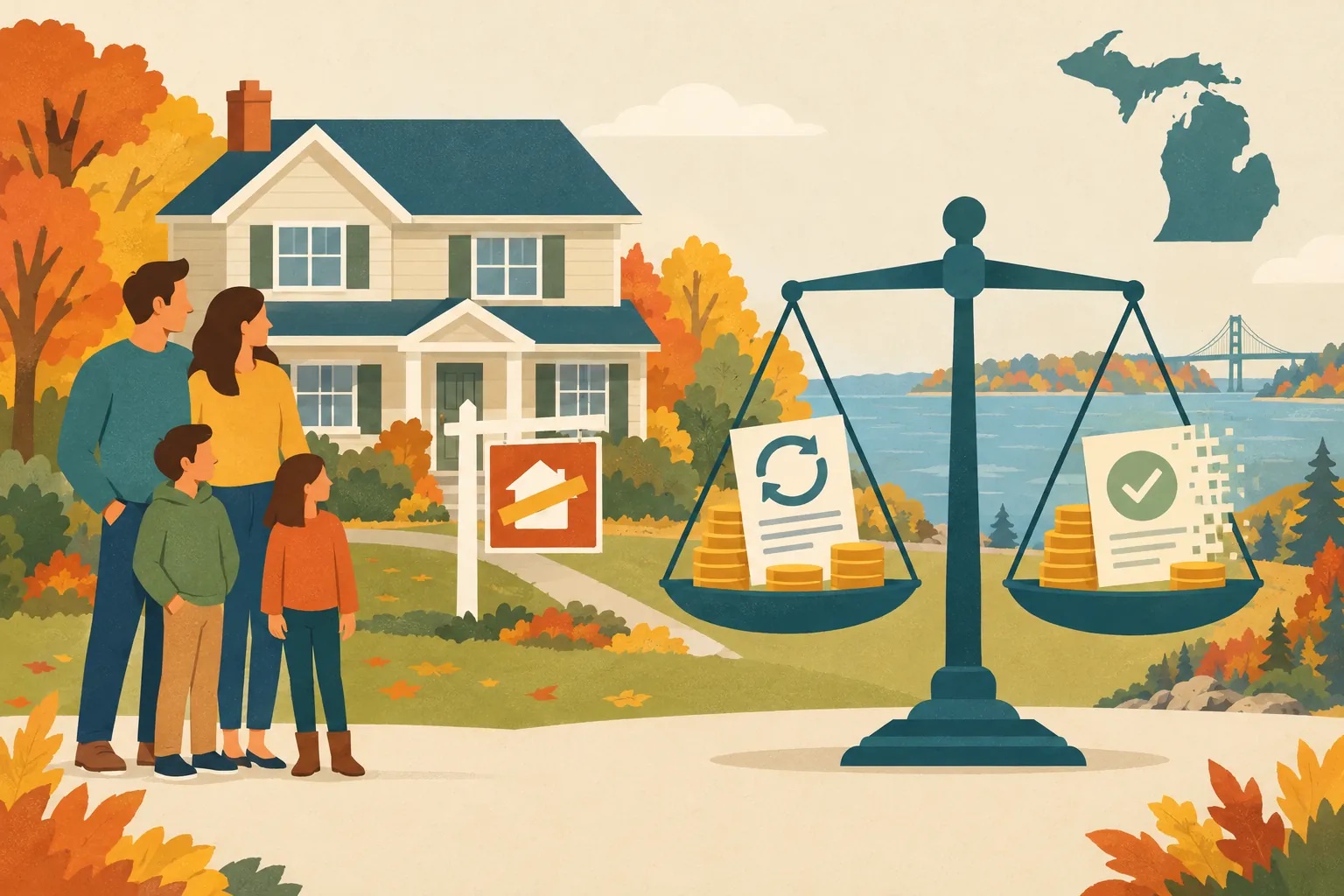
Chenoa Fund’s second mortgage comes in two versions, and the forgivable one is not automatically the better deal.
- Repayable: a 10-year loan at an interest rate one percentage point above your first mortgage’s rate. It’s a separate monthly bill, and it counts in your DTI. On $10,500, plan on roughly $120 to $130 a month for 120 months, depending on your rate.
- Forgivable: a 30-year loan at 0% with no monthly payment. It can be forgiven after your first 36 payments on the FHA loan, under an on-time rule that differs for the 3.5% and 5% amounts.
Here’s the part that doesn’t make the headline. Assistance costs money to provide, and that cost usually shows up in the interest rate on your FHA loan. The forgivable version tends to carry a higher first-mortgage rate than the repayable version, and the 5% amount is priced differently from the 3.5% amount, usually higher. That rate applies to the whole loan, roughly $290,000 on our $300,000 example, for as long as you keep it.
So do the math before you choose. On a loan that size, every quarter point of rate is about $48 a month. Ask for a quote on both versions the same day, then compare the gap:
- A quarter point: forgivable costs about $48 a month more in interest and saves a second-mortgage payment of roughly $125. Forgivable wins.
- A half point: about $96 a month against $125. Forgivable still wins for the first 10 years, by about $3,500 in total. Then the repayable second is paid off, the higher rate keeps going, and the lead is gone around year 13.
- Two-thirds of a point or more: the extra interest is bigger than the second-mortgage payment. Repayable costs less from the first month.
Rates move daily, so I won’t print one here. Check today’s Michigan mortgage rates, then get the two quotes.
The rules that catch people after closing
Chenoa Fund’s forgiveness has conditions, and they matter more than the headline. Three of them cause most of the trouble.
The on-time rule depends on which amount you took. With 3.5% assistance you need 36 consecutive on-time payments, and one late payment restarts the count. Pay late in month 30 and you’re back to month one.
With 5% assistance there’s no restart. If any of your first 36 payments is 60 or more days late, the second can’t be forgiven after 36 payments at all. It stays at 0% with no payment, and it comes due when you sell, transfer or refinance the home.
Forgiveness isn’t automatic. Once you’ve met the condition, you have to ask CBC Mortgage Agency to forgive the second, and you pay the fee to process the lien release. Put a reminder on your calendar for month 37.
Selling or refinancing early makes the full amount due. Refinance during the first 36 payments and the second loses its forgivable status for good and has to be paid off. Sell before it’s forgiven and it’s paid from your proceeds. A repayable second’s remaining balance typically gets paid off at a sale or refinance too.
Here’s where this usually goes sideways. Someone buys with the forgivable option, rates drop 18 months later, and they call about refinancing. The savings look good until we add the $10,500 that comes due. Often the answer is to wait for payment 36.
How does Chenoa Fund compare to MSHDA down payment assistance in Michigan?

For Michigan buyers, the main alternative to Chenoa Fund is the MI 10K DPA Loan from MSHDA, and the two suit different people. MSHDA is the Michigan State Housing Development Authority, the state’s housing agency. Its assistance is a 0% loan of up to $10,000 with no monthly payment, but it comes with income limits and, in most of the state, a first-time buyer rule.
| Chenoa Fund repayable | Chenoa Fund forgivable | MSHDA MI 10K DPA | |
|---|---|---|---|
| Assistance amount | 3.5% or 5% of the price | 3.5% or 5% of the price | Up to $10,000 |
| On a $300,000 home | $10,500 or $15,000 | $10,500 or $15,000 | $10,000 |
| Monthly payment on the assistance | Yes, for 10 years | None | None |
| Interest on the assistance | First-mortgage rate plus 1 point | 0% | 0% |
| Does it ever go away? | Paid off after 120 payments | Can be forgiven after 36 payments if you meet the on-time rule and request it | No. Due when you sell, refinance, pay off the first mortgage or move out |
| Minimum credit score | 600 | 600 | 640 |
| Income limits | None | None | Yes, by county and household size |
| First-time buyer required | No | No | Yes, except in targeted areas |
| Price cap | FHA loan limit | FHA loan limit | $566,355 sales price |
| Homebuyer education | If a score is under 640 | If a score is under 640 | Required for everyone |
| First mortgage | 30-year fixed FHA | 30-year fixed FHA | MSHDA MI Home Loan |
Sources, as of November 2026: CBC Mortgage Agency program matrix, our lender’s Chenoa Fund guidelines, and MSHDA’s MI Home Loan and MI 10K DPA Loan pages.
My rule of thumb: if you qualify for MSHDA or another Michigan down payment assistance program, price it first. No payment and no forgiveness clock to protect is a strong starting point, even though the $10,000 never goes away. Chenoa earns its place when MSHDA says no.
The situation that comes up most: a couple sold a home two years ago, rented while they relocated to Grand Rapids, and now wants to buy again. MSHDA counts them as repeat buyers because they owned within the last three years, so outside a targeted area they’re out. Their combined income is over the county limit anyway. Chenoa has neither rule.
How much cash do you still need at closing?

Zero down is not zero cash. Chenoa Fund covers the down payment, but closing costs and prepaid items are separate, and on a $300,000 Michigan purchase they commonly land between $8,000 and $12,000.
You have four ways to cover them:
- Take the 5% option. The extra 1.5% ($4,500 on our example) can go toward closing costs, prepaids and other loan fees.
- Ask the seller. FHA lets a seller pay up to 6% of the price or the appraised value, whichever is lower, toward your costs. In a competitive market you’ll give something up to get it, usually price.
- Use gift funds. A family member, your employer, a close friend or a charity can give you money for closing. You’ll need a signed gift letter saying it doesn’t have to be repaid.
- Bring savings. Even $3,000 to $5,000 changes what you can negotiate.
The most common version of this: a buyer hears “no money down,” makes an offer, and then gets a Loan Estimate (the three-page form a lender sends within three business days of your application) asking for $9,000. Nothing went wrong. Nobody explained the difference between a down payment and cash to close.
Ask for a written cash-to-close estimate before you shop, and budget for what you pay before closing: the inspection, the appraisal and your earnest money deposit.
One cost follows you past closing: FHA mortgage insurance, which protects the lender if you default. As of November 2026, this mortgage insurance premium (MIP) is 1.75% of the loan upfront, usually added to your balance, plus 0.55% a year for most 30-year loans (HUD Mortgagee Letter 2023-05). On our example that’s $5,066 upfront and about $133 a month, for the life of the loan when you put less than 10% down.
Chenoa Fund pros and cons: who shouldn’t use it?
Chenoa Fund’s pros are easy to list: no down payment, a 600 credit score, no income limits and no first-time buyer rule. The cons are a higher rate, a second loan against your home and forgiveness rules you can trip over. That makes it the wrong tool for some buyers. Skip it, or at least price the alternative, if:
- You already have 3.5% saved and a score near 680 or higher. A standard FHA loan, or a conventional loan with 3% down, will usually get you a lower rate. Over 10 years that can be worth more than the assistance.
- You expect to sell or refinance within three years, or your payments sometimes run late. Either one can cost you the forgiveness. Look at the repayable version, or wait.
- Your budget is already at its limit. The higher rate, and the second payment if you choose repayable, leave less room for everything else.
How do you apply with a Chenoa Fund lender in Michigan?
You apply for Chenoa Fund in Michigan through an approved lender or broker like Riverbank Finance, not through CBC Mortgage Agency. We take your application, run the automated approval, reserve the assistance and lock your rate. Most FHA purchases close in 30 to 45 days once you have an accepted offer. Here’s the order I’d do it in:
- Pull your credit reports at annualcreditreport.com and dispute any errors before a lender pulls your scores. The breakpoints that matter are 600, 620 and 640. If you’ve frozen your credit, lift the freeze at all three bureaus first.
- Ask for three quotes on the same day: a standard FHA loan, Chenoa repayable and Chenoa forgivable. Compare the rate, the total monthly payment and the cash to close on each. Our FHA mortgage calculator will get you close before you call.
- Take the homebuyer course early if any borrower’s score is under 640, so it doesn’t hold up your closing.
- Negotiate the seller’s contribution in your offer. Discount points aren’t allowed on these loans, but a seller or builder can pay for a temporary buydown (2-1, 1-1 or 1-0) that lowers your rate for the first year or two. You still have to qualify at the full rate.
- Set up autopay before your first payment is due. It’s the cheapest way to protect your forgiveness.
Frequently asked questions
Do you have to pay back Chenoa Fund down payment assistance?
It depends on the version. The repayable second mortgage is paid back monthly over 10 years. The forgivable second has no payment and can be forgiven after your first 36 payments on the FHA loan, if you meet the on-time rule and request forgiveness. Sell, transfer or refinance before then and the full amount comes due.
What credit score do you need for Chenoa Fund?
The minimum is 600. Every borrower needs a credit score, and the lowest middle score is the one that counts. Borrowers under 640 must complete homebuyer education. The loan also needs an automated approval. A Chapter 7 or 13 bankruptcy must be discharged for two years, and a foreclosure needs three.
Does Chenoa Fund have income limits?
No. CBC Mortgage Agency’s current program has no income limits, which is the main difference from state housing agency programs like MSHDA’s. Older versions of Chenoa capped income at 115% or 135% of area median income, and some websites still list those caps. They no longer apply.
Is the Chenoa Fund legit?
Yes. CBC Mortgage Agency is a housing finance agency owned by the Cedar Band of Paiutes and registered under NMLS #1186381. In 2019 HUD issued a letter that would have restricted the program. A federal court blocked it, and FHA rescinded the letter that August. The program has operated nationally since.
Can you use Chenoa Fund to buy a manufactured home?
Not through Riverbank Finance. CBC Mortgage Agency’s program matrix permits manufactured housing, but lenders can exclude it, and the lender we use for Chenoa loans does. Modular homes, site-built single-family homes, townhomes, HUD-approved condos and two-unit homes are eligible. If you’re buying a manufactured home, ask us about other loan options.
The takeaway
Chenoa Fund down payment assistance gets you into a home without a down payment, with a 600 score and no income cap. You pay for that through the interest rate. Whether it’s worth it comes down to one comparison: same-day quotes for standard FHA, Chenoa repayable and Chenoa forgivable, measured against how long you’ll keep the loan.
Buying in Michigan? Riverbank Finance offers Chenoa Fund statewide. We’ll price all three side by side and show you the monthly payment and cash to close on each. Talk to a loan officer, or start your pre-approval today.