
If you bought or refinanced your home in 2023 or 2024 — when mortgage rates were at their peak — there’s a good chance you’re paying more than you need to right now. And if you have a VA loan, there’s a program built specifically to fix that: the VA IRRRL.
Most veterans have never heard of it. Plenty who have heard of it don’t fully understand it. That’s a shame, because it’s genuinely one of the best refinance options available to anyone in the mortgage market today.
Here’s everything you need to know about the VA IRRRL in 2026 — what it is, who qualifies, what it costs, and whether it makes sense for your situation right now.
What Is the VA IRRRL?
IRRRL stands for Interest Rate Reduction Refinance Loan. It’s a refinance program offered through the U.S. Department of Veterans Affairs, and it’s designed to do one thing: help veterans lower their rate or payment on an existing VA loan with as little friction as possible.
You might also see it called the VA Streamline Refinance. That name is earned. The VA stripped away most of what makes refinancing painful — no appraisal in most cases, no income verification, minimal paperwork. If you already have a VA loan, you’ve already proven your eligibility. The IRRRL is built on that existing foundation.
Think of it like a fast lane. Standard refinances have you starting over from scratch: employment verification, tax returns, property appraisal, the works. The VA IRRRL skips most of that because you’ve already done it once.
One veteran helped with a mortgage described his IRRRL as “a no brainer.” He went from application to closing in under three weeks, dropped his rate by 0.75%, and saved over $200 a month. With our e-sign process, digital verifications and little paperwork, there was no downside to dropping his rate.
VA IRRRL Requirements: Who Qualifies in 2026
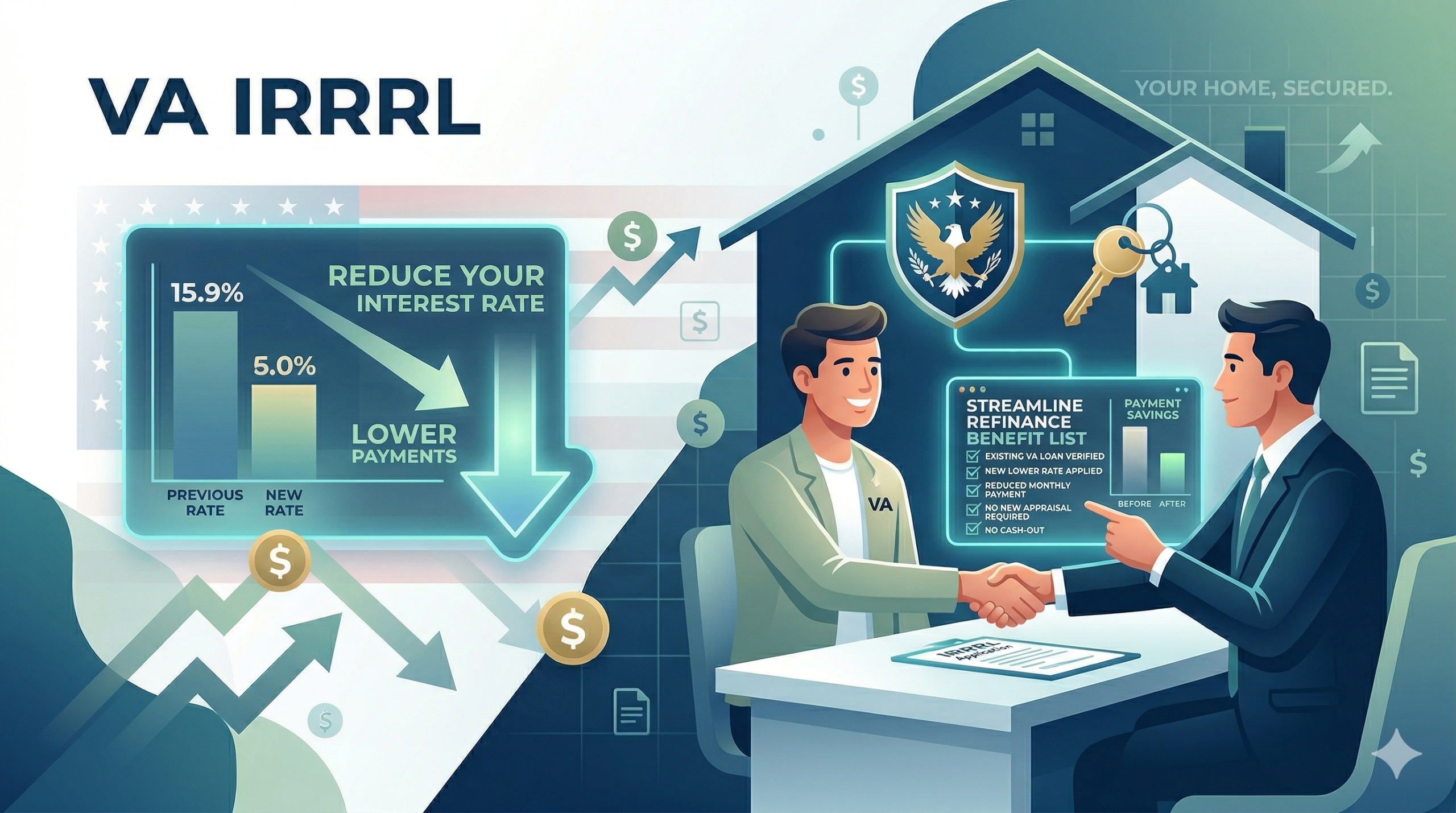
The VA IRRRL isn’t open to everyone — but if you have an existing VA loan, you’re already most of the way there. Here’s what you need to qualify:
- You currently have a VA-backed loan. The IRRRL is VA-to-VA only. You can’t use it to refinance a conventional or FHA loan.
- Net tangible benefit. The refinance must actually help you. That means a rate drop of at least 0.5% (if it’s a fixed-to-fixed refinance), a switch from an adjustable rate to a fixed rate, or a shorter loan term.
- 210-day seasoning. At least 210 days must have passed since your first payment due date on the current VA loan, and you must have made at least six monthly payments.
- Clean payment history. No more than one late payment in the past 12 months.
- Prior occupancy. You must have previously lived in the home as your primary residence. You don’t have to live there now — so this works even if you’ve since moved or turned the property into a rental.
That last point surprises a lot of people. If you PCS’d to a new duty station and converted your old home to a rental, you can still use the IRRRL to lower the rate on that property. That means more monthly rental income with zero extra hassle.
VA IRRRL Rates in 2026: What to Expect
VA IRRRL rates in 2026 have been running between roughly 5.25% and 6.5%, depending on the lender and your credit profile. That’s typically 0.25% to 0.5% lower than comparable conventional refinance rates — one of the ongoing advantages of VA-backed lending.
If you locked in a rate during the peak of 2023 or 2024, current rates likely represent a meaningful drop. On a $400,000 loan, a 0.5% rate reduction saves around $116 per month — or more than $41,000 in interest over the life of the loan.
Rates vary by lender, so it pays to work with a mortgage broker that can shop around on your behalf. Some lenders advertise a very low rate but offset it with higher origination fees. Always compare APR — not just the interest rate — to get an apples-to-apples comparison.
Also worth knowing: many lenders offer a “no-closing-cost” IRRRL, where fees are either rolled into the new loan balance or offset by accepting a slightly higher rate. This can be a good option if you’re short on cash at closing or if you’re not sure how long you’ll stay in the home.
The Big Advantages of a VA IRRRL
The streamline part is real. Here’s what makes the VA IRRRL stand out from every other refinance option:
No Appraisal Required (In Most Cases)
The VA waives the appraisal requirement for IRRRLs. That saves you $625+ in fees and eliminates the risk of a low appraisal killing your deal. If your home’s value has dropped since you bought, it doesn’t matter — you can still refinance. Some lenders may order an appraisal for their own underwriting, but this is the exception, not the rule.
No Income Verification
Most IRRRL lenders don’t require tax returns, W-2s, or pay stubs. Your employment situation simply doesn’t affect your eligibility. That’s a huge deal for self-employed veterans, those on disability, or anyone whose income looks complicated on paper.
Low Funding Fee
The VA funding fee for an IRRRL is just 0.5% of the loan amount — compared to 2.15% to 3.3% for a standard VA purchase loan. And if you receive VA disability compensation, you may qualify for a complete waiver of the funding fee altogether. Your lender will pull a certificate of eligibility before closing which will confirm if you can waive the funding fee.
Fast Closing
Most VA IRRRLs close in 10 to 20 days. A standard refinance typically takes 30 to 45. The stripped-down documentation is what makes it move so quickly.
No Out-of-Pocket Costs Required
You can roll closing costs into the new loan or accept a slightly higher rate in exchange for a lender credit. Either way, you don’t need cash at the table to make the refinance happen.
The 36-Month Recoupment Rule: Do the Math First
Here’s one thing veterans sometimes overlook: the VA requires that the total cost of the refinance be recovered through your monthly savings within 36 months. This is called the recoupment rule, and it’s there to protect you from refinancing into a deal that costs more than it saves.
Use our VA Loan Calculator to estimate your new payments!
The math is simple. Take your total closing costs (excluding the funding fee) and divide by your monthly savings. If that number is 36 or less, you pass. If not, the VA considers the refinance not beneficial and won’t allow it to go through.
Example: If your closing costs are $3,000 and you’re saving $150 per month, your break-even is 20 months. That passes. If your costs are $6,000 and you’re only saving $100 a month, that’s 60 months — and you’d be blocked from proceeding.
A good lender will run this calculation with you upfront. If they don’t bring it up, ask. It’s not a technicality — it’s a meaningful check that the refinance actually benefits you.
How to Apply for a VA IRRRL
You don’t go directly through the VA. Like your original VA loan, you apply through a private lender — a bank, mortgage company, or credit union that’s approved to offer VA loans.
You don’t need a new Certificate of Eligibility (COE) in most cases. Your lender can verify your prior VA loan through the VA’s portal. If you still have your original COE, bring it — but it’s not a deal-breaker if you don’t.
The basic steps:
- Compare rates and fees from at least two or three VA-approved lenders.
- Confirm you meet the seasoning and net tangible benefit requirements.
- Review the break-even analysis your lender provides before committing.
- Submit your application — documentation requirements are minimal.
- Close in as little as two to four weeks.
One thing to watch for: if a lender is pushing you toward an IRRRL with unusually low rates and promises that sound too good — like skipping payments or zero costs, period — slow down. The VA specifically warns about misleading refinance offers targeting veterans. If the pitch sounds like magic, verify everything in writing before you sign anything.
Is a VA IRRRL the Right Move for You Right Now?
Honestly, there’s no universal answer. But here are the situations where a VA IRRRL makes the most sense in 2026:
- You closed your VA loan in 2023 or 2024 at a rate above 6.25% and current rates are meaningfully lower.
- You have an adjustable-rate VA mortgage and want to lock in a fixed payment before rates potentially rise again.
- You’ve been in your home at least 210 days and have made six payments on your current loan.
- Your break-even is under 36 months — meaning the savings actually justify the cost.
- You’re a disabled veteran who may qualify for the funding fee waiver, making the cost of refinancing even lower.
If you’re not sure whether the numbers work, the easiest first step is a conversation with a VA-approved lender. Most will run the math with you in under 15 minutes — no commitment, no application, no pressure. You’ll know quickly whether it makes sense.
Watch out for common misconceptions about VA IRRRL
The veterans who get the most out of their VA benefits are the ones who stay aware of what’s available to them. The IRRRL is one of the most valuable tools in that toolbox. If rates have dropped since you closed, it’s worth a look.
Ready to see if a VA IRRRL makes sense for you? Contact us today for a free rate comparison and break-even analysis — no obligation, no pressure.